

Every fall, retirement savers get the same news: the IRS raises the limits for next year. For 2027, the 2027 401(k) contribution limit is projected to rise by $1,000 to $25,500. But there’s an important detail many headlines skip. The IRS hasn’t announced the official numbers yet.
That doesn’t mean you’re flying blind. The limits follow an inflation formula, and this year’s hot inflation readings have made the calculation easier to predict. Here’s what’s confirmed for 2026, what’s projected for 2027, and what you can sensibly do before the official notice arrives.
- Trump’s Russian Diesel Deal, Explained
- Why Memory Chip Stocks Crashed This Week
- Inflation Jumped to 3.7% in September.
- Social Security Benefits Will Rise 3.6% in 2027
Are the 2027 401(k) and IRA Limits Official Yet?
No. The IRS typically publishes its cost-of-living adjustments for retirement plans in late October or November, so every 2027 figure you see right now is a projection, not a rule. The best-known estimates come from the benefits consultancy Milliman, and other tax calculators using the same statute reach similar numbers.
One useful detail: the 401(k) limit is indexed to the average inflation reading from July through September. With the September inflation report now out, the main input is known, which is why most calculations have converged on $25,500. Earlier in the year, some estimates were closer to $25,000, so if you’ve seen different numbers elsewhere, that’s likely why.
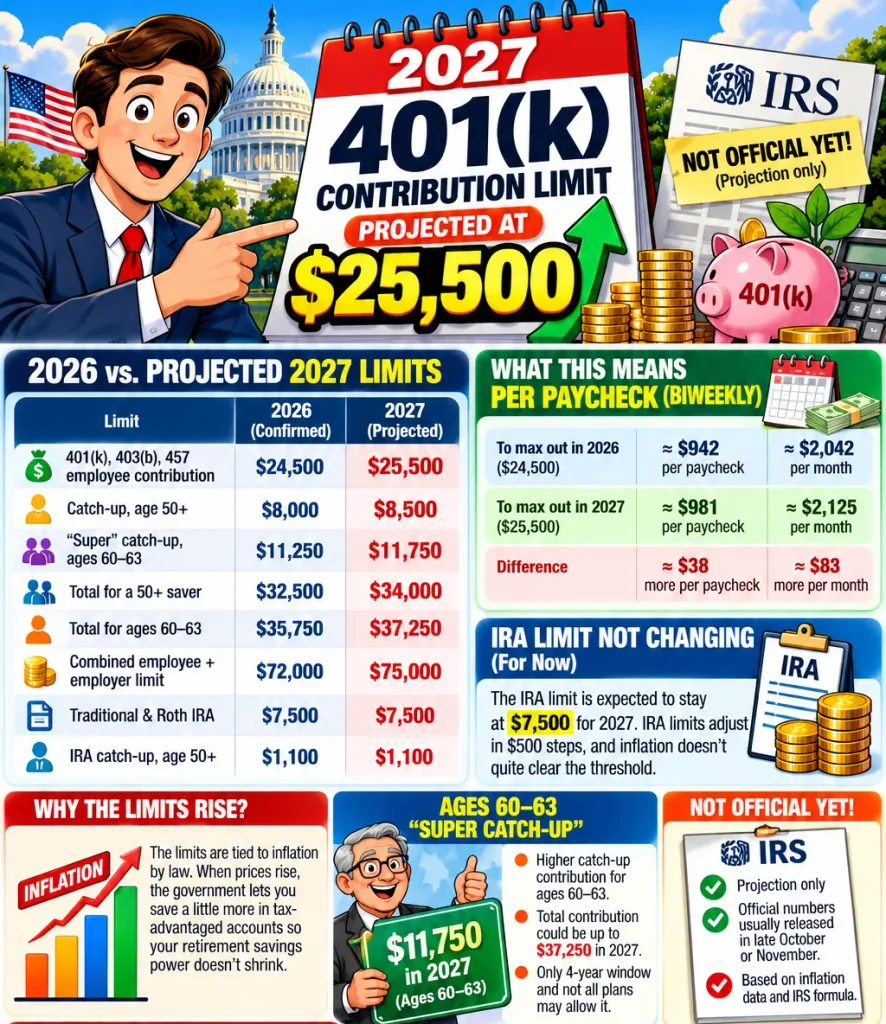
2026 vs. Projected 2027 Limits
| Limit | 2026 (confirmed) | 2027 (projected) |
|---|---|---|
| 401(k), 403(b), 457 employee contribution | $24,500 | $25,500 |
| Catch-up, age 50 and older | $8,000 | $8,500 |
| “Super” catch-up, ages 60 to 63 | $11,250 | $11,750 |
| Total for a 50+ saver | $32,500 | $34,000 |
| Total for ages 60 to 63 | $35,750 | $37,250 |
| Combined employee + employer limit | $72,000 | $75,000 |
| Traditional and Roth IRA | $7,500 | $7,500 |
| IRA catch-up, age 50 and older | $1,100 | $1,100 |
Notice that the IRA limit isn’t projected to move. IRA limits only adjust in $500 steps, and the inflation math doesn’t quite clear the threshold for a full step, so most projections show it staying at $7,500. That could still change if the official numbers surprise.
What the Increase Means Per Paycheck
A $1,000 higher limit sounds modest, but it helps to see it in paycheck terms. If you’re paid every two weeks (26 paychecks a year), reaching the limit works out like this:
| Per biweekly paycheck | Per month | |
|---|---|---|
| To max out in 2026 ($24,500) | about $942 | about $2,042 |
| To max out in 2027 ($25,500) | about $981 | about $2,125 |
| Difference | about $38 more | about $83 more |
Most people don’t contribute the maximum, and there’s no rule that says you should. The numbers are simply a ceiling. What matters more for most savers is whether they’re contributing enough to capture their full employer match, which is effectively free money added to your account on top of your own contributions.
Why the Limits Rise at All
The limits are tied to inflation by law, so they rise as prices rise. That’s the same principle behind the Social Security cost-of-living adjustment announced this month, which came in at 3.6%. When consumer prices climb, the government lets you shelter a little more from taxes in retirement accounts so that your savings power doesn’t shrink in real terms. Our breakdown of the September inflation report explains why prices have been rising faster lately.
The 60-to-63 “Super Catch-Up,” Explained
One of the more useful parts of recent retirement law is a higher catch-up contribution for people ages 60 through 63. Instead of the standard catch-up that applies at 50 and older, this narrow age window gets a larger one, projected at $11,750 for 2027. Combined with the standard limit, that would let someone in that age range contribute up to about $37,250 to their workplace plan in 2027.
It’s a short window, only four years, and it only helps if your plan allows catch-up contributions and you have the cash flow to use them. But for people who started saving late, it’s a meaningful opportunity to close the gap before retirement.
What to Do Before the Official Numbers Arrive
You don’t need to wait for the IRS to take sensible steps.
- Check your current contribution rate. If you set your 401(k) as a percentage of pay, you may not need to change anything. If you set a fixed dollar amount, you’ll need to update it for 2027.
- Capture the full employer match first. Before worrying about maxing out, make sure you’re contributing at least enough to get the full match your employer offers.
- Plan for an increase, not a jump. Even if you can’t hit the new maximum, raising your contribution by one percentage point is a common, manageable step.
- Remember the IRA is separate. The IRA limit is independent of your 401(k) limit, so you can contribute to both, though income limits and workplace plan coverage can affect whether IRA contributions are deductible. If you’re opening one, a comparison of brokerage accounts is a good place to start.
- Wait for the official notice before making big moves. If you’re planning around the exact dollar figures, confirm them on the IRS website once the announcement is out.
The 2027 401(k) contribution limit is projected at $25,500, with an $8,500 catch-up and a $11,750 super catch-up for ages 60 to 63, while the IRA limit is expected to stay at $7,500. Those are projections based on inflation data, not official figures, and the IRS is expected to confirm the real numbers in late October or November. Until then, the most useful steps are the unglamorous ones: capture your full employer match, check whether your contribution is set as a percentage or a fixed amount, and plan for a modest increase. As always, this isn’t personalized advice, and it’s worth talking to a tax professional about how the limits apply to your own situation.
General information only, not personalized financial or tax advice. The 2027 figures below are projections until the IRS publishes its official notice.

