

Apple has finally built a smart home hub. Apple HomeView, a $299 smart display with a 7-inch screen and a rebuilt version of Siri called Siri AI, was unveiled on October 13 and goes on sale November 13. It’s Apple’s most direct move yet into a category Amazon and Google have owned for years.
The announcement came with a lot of excitement and a few catches, including the fact that it won’t be sold in the European Union at launch. Here’s what HomeView actually is, what the fine print says, and who should think twice before buying.
A note on what this article is: HomeView hasn’t shipped, so this is an explainer based on Apple’s announcement and early coverage, not a hands-on review.
- The 2027 401(k) Contribution Limit Is Projected at $25,500.
- Trump’s Russian Diesel Deal, Explained
- Why Memory Chip Stocks Crashed This Week
- Inflation Jumped to 3.7% in September.
What Is Apple HomeView?
HomeView is a tabletop smart display, essentially a small touchscreen with a speaker that sits in your kitchen or living room and acts as a control center for your home. According to Apple and early coverage, it includes:
- A 7-inch Liquid Retina touchscreen on an aluminum and stainless steel base
- An A18 chip, the same family of processor used in recent iPhones
- Siri AI for voice and touch requests
- Facial recognition that can tell up to six household members apart
- Smart home controls for lights, thermostats, door locks, and blinds
- FaceTime calls, music, recipes, calendar events, and photos
- Camera monitoring, with Apple saying the display can show up to nine camera feeds at once
Think of it as the answer to Amazon’s Echo Show and Google’s Nest Hub, built around the Apple ecosystem.
Apple HomeView Price and Release Date
The HomeView price is $299 in the US, and Apple offers a wall-mounted version at the same price as the tabletop model. Pre-orders opened on October 13, and the general release date is November 13.
Apple also announced a new $149 HomePod mini with Siri AI support, for people who want the assistant without a screen, with availability starting October 30.
There’s one small piece of context on pricing. Before launch, Bloomberg had reported the hub would cost around $350, so $299 came in lower than the rumors suggested. That’s still not cheap compared to many rival smart displays, but it’s less than the rumor mill predicted.
What Siri AI Actually Is, and the Fine Print
The headline feature is Siri AI, which Apple describes as an entirely new version of Siri that’s more capable and conversational than the old assistant. Apple reportedly delayed HomeView for years until Siri AI was ready to anchor it, which says something about how central it is to the product.
But the fine print matters, and it’s worth reading before you pre-order:
- It’s a beta. Siri AI is launching in beta on HomeView, running software version 27.2.
- English only, and only in four countries. It’s available in the US, UK, Canada, and Australia at launch.
- It needs your phone for the personal stuff. For Siri AI to use things like your Messages, Calendar, and Apple Music playlists, HomeView relies on a paired iPhone or iPad that supports Apple Intelligence. Without one, the personalized features are limited.
- There may be limits and a future fee. Apple has said some capabilities may have usage limits, and that expanded access may be offered for a fee down the road.
In other words, it may not behave like a fully finished product on day one. That’s normal for a first-generation device with a brand-new assistant, but it’s a reason to read early reviews before buying.
What’s Missing
No App Store. Unlike its rivals, HomeView doesn’t have an app marketplace. Instead, third-party audio and video services that support Apple’s CarPlay architecture will be available. That keeps the experience simpler and more controlled, but it also means fewer options than the Echo Show or Nest Hub have built up over years.
No EU launch. Apple says HomeView isn’t being sold in the European Union because Siri AI isn’t currently available in iOS there. Apple has reportedly said it’s working with the EU on a path forward. For readers in the UK and Canada, which are included at launch, this isn’t an issue, but European buyers will have to wait.
Who Should Buy It, and Who Should Wait
It’s probably a good fit if you already live in the Apple ecosystem, with an iPhone, iPad, and Apple Music, and want a central, shared screen for your household. The face recognition for multiple users and the tight integration with your Apple devices are the main selling points.
It’s probably worth waiting if you use an Android phone, rely heavily on third-party apps or a wide range of smart home brands, or you’re nervous about buying a beta assistant. Early adopters of new voice assistants have often hit rough edges in the first few months.
It may not make sense if you only want basic smart speaker features. A cheaper device, including some of the inexpensive smart home gadgets that cost far less, can handle timers, music, and light switches without a $299 price tag. The HomePod mini at $149 is also a lower-cost way to get Siri AI.
A Quick Word on Cameras and Privacy
HomeView combines a camera, microphones, face recognition, and camera feeds from other devices in one always-on screen. That’s convenient, but it also concentrates a lot of sensitive capability in one spot.
Think about where you place it. A bedroom or bathroom is probably the wrong place for any device with a camera and microphone. If you have guests or a nanny, it’s courteous to tell them what the device can see and hear. And as with any connected device, keep your software updated and use strong account security, since smart home gadgets are a common target.
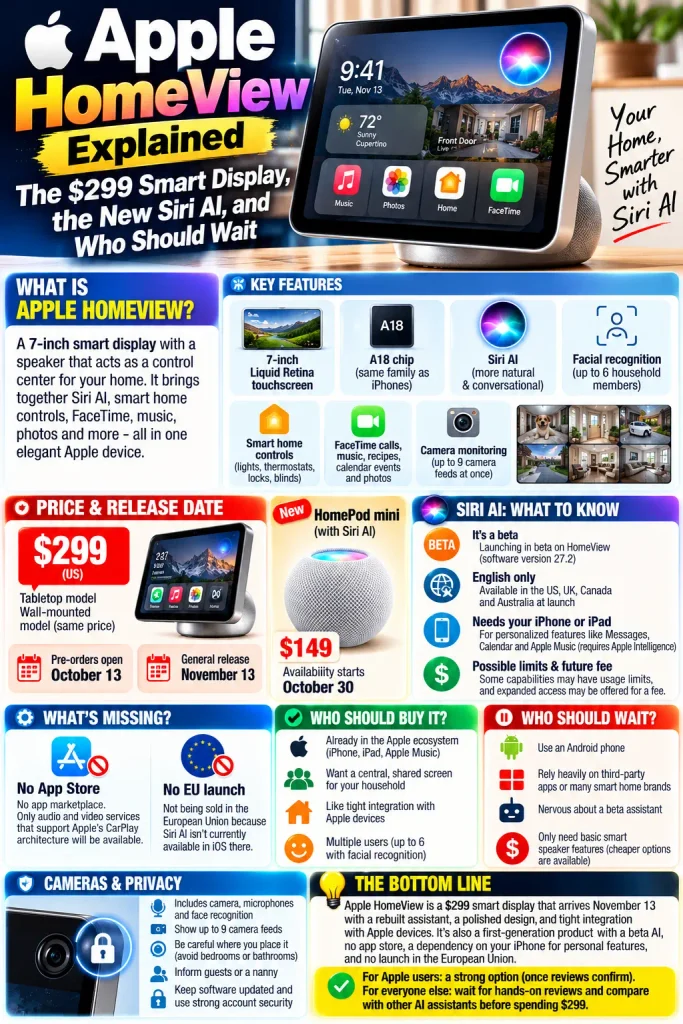
Apple HomeView is a $299 smart display that arrives November 13 with a rebuilt assistant, a polished design, and tight integration with Apple devices. It’s also a first-generation product with a beta AI, no app store, a dependency on your iPhone for personal features, and no launch in the European Union.
For loyal Apple users, it may be an easy yes once reviews confirm the experience works as promised. For everyone else, the smartest move is probably to wait for hands-on reviews after launch, and to compare it with how other AI assistants perform before spending $299.