

Every investing style gets marketed with the same implicit promise: figure out the right approach, put in the work, and the returns follow. What actually separates these three approaches has less to do with which one is “better” in the abstract and a lot more to do with time commitment, risk tolerance, and, frankly, how honest you’re willing to be with yourself about the odds involved.
Here’s what each style actually requires, and what the real data says about how often each one actually works.
Day Trading: The Highest Time Commitment, the Lowest Success Rate
Day trading means opening and closing positions within the same trading day, sometimes holding a stock for minutes, never overnight. It requires constant attention during market hours, fast decision-making, and, in the US, at least $25,000 in your account to comply with the pattern day trader rule if you’re trading through a standard margin account.
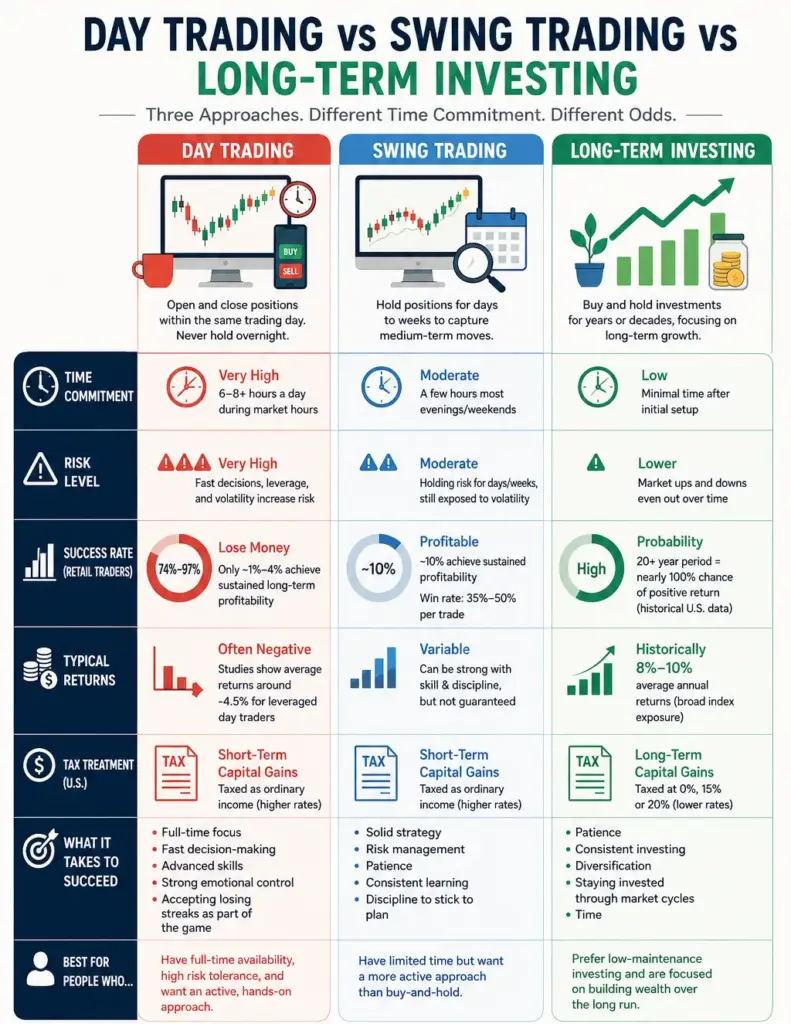
The honest numbers here are stark. Multiple independent studies, spanning markets in Brazil, Taiwan, and Europe, converge on a similar range: somewhere between 74% and 97% of retail day traders lose money over time. Long-term, sustained profitability, meaning someone who’s still consistently profitable after several years, sits at roughly 1% to 4% of retail participants. Even in controlled trading competitions specifically attracting skilled, confident, self-selected traders, roughly 90% still finished with losses.

Traders who use leverage to amplify their day trades fare even worse on average, with studies showing average returns around negative 4.5% specifically among leveraged day traders. The appeal is obvious: fast feedback, the chance at outsized short-term gains, and the excitement of active markets. The reality is that day trading is closer to a specialized profession requiring years of deliberate practice than a side activity most people can pick up successfully in their spare time, and it demands treating inevitable losing streaks as a cost of doing business rather than a sign to quit or double down.
Swing Trading: A Meaningfully Different Risk Profile
Swing trading holds positions for days to weeks rather than minutes, using both technical and fundamental analysis to catch medium-term price moves. It requires far less constant attention than day trading, no need to watch a screen all day, but still meaningfully more active involvement than simply buying and holding.
Swing trading’s success rates, while still difficult, look genuinely better than day trading’s. Roughly 10% of swing traders achieve sustained, long-term profitability, and experienced swing traders report win rates in the 35% to 50% range on individual trades. That’s not a typo, a strategy can be profitable with a win rate under 50% if the winning trades are sized larger than the losing ones, a risk-to-reward approach that’s central to how profitable swing traders actually operate. The reduced trading frequency compared to day trading also means lower transaction costs eating into returns, and daily or multi-day charts filter out a lot of the short-term noise that trips up day traders reacting to minute-by-minute price swings.
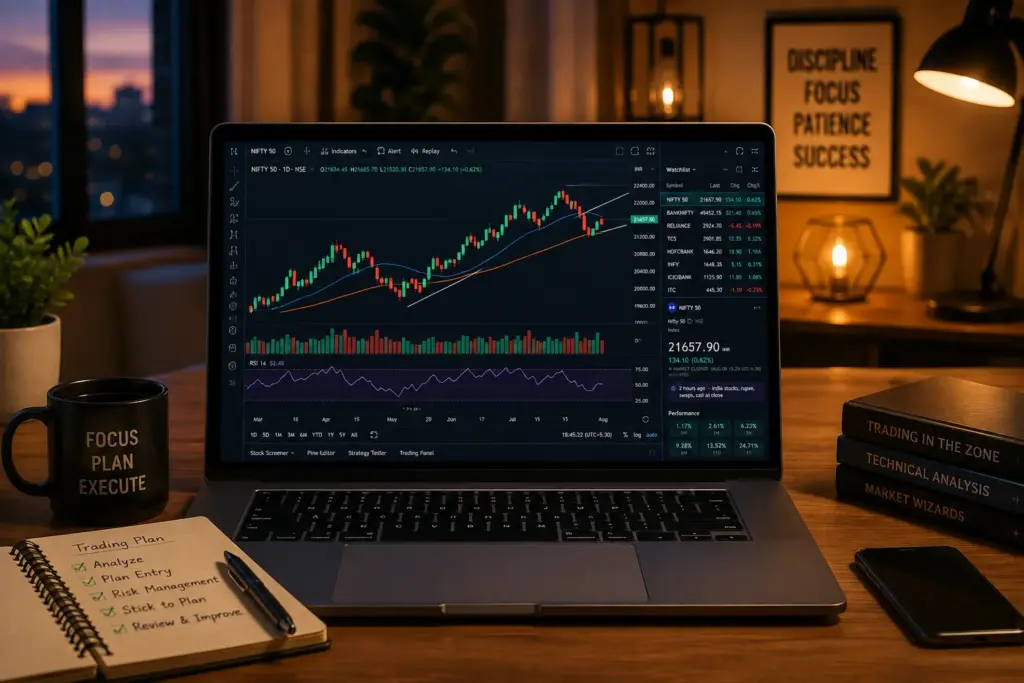
It’s still a demanding, active approach. It just demands less of your literal daily schedule than day trading does, while still requiring real skill development most beginners underestimate.
Long-Term Investing: The Least Exciting, Most Statistically Reliable Option
Long-term investing means buying and holding, typically through index funds, ETFs, or individual stocks, for years or decades, largely ignoring short-term price swings in favor of the market’s historical long-term trend.
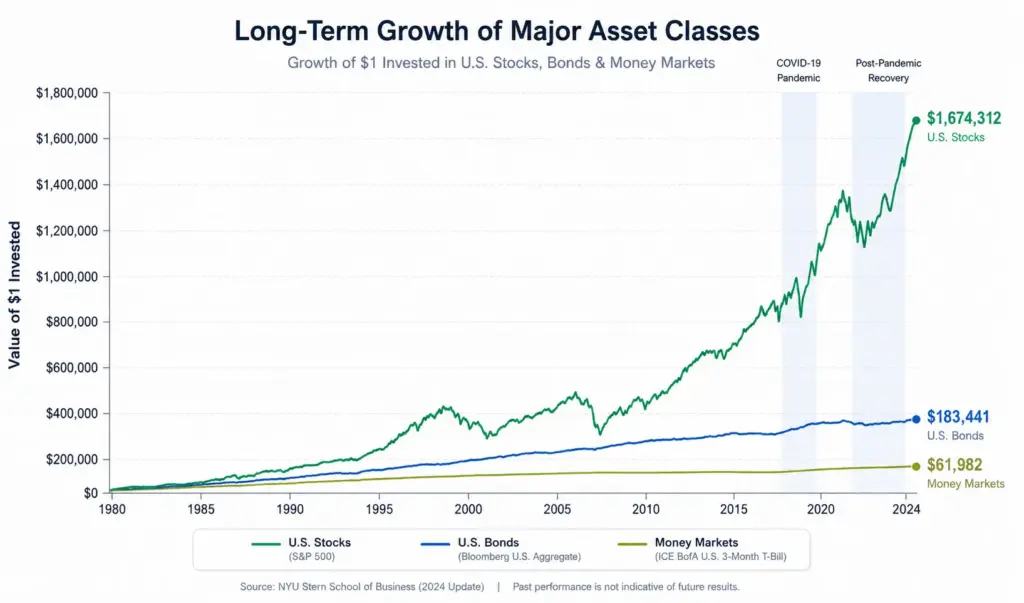
This is the approach with the numbers most clearly in its favor. Long-term investors have historically captured average annual returns in the 8% to 10% range through broad index exposure, and over holding periods of 20 years or longer, the probability of a positive return approaches nearly 100%, based on historical US market data. Retail day traders and active swing traders, by contrast, tend to underperform major benchmarks by an estimated 3% to 5% annually once you account for transaction costs, overtrading, and common behavioral mistakes like panic-selling during downturns.
One statistic tends to land harder than any other on this topic: missing just the 10 best trading days over a 20-year period can cut total returns by more than half. Those best days cluster unpredictably, often during the same volatile stretches that scare active traders into sitting out. The investors who stay invested through the scary periods, rather than trying to time an exit and a cleaner re-entry, are the ones who actually capture those days.
The Tax Difference Is Bigger Than Most Beginners Realize
Holding period doesn’t just affect strategy, it directly affects what you owe. In the US, positions held for a year or longer qualify for long-term capital gains rates, generally 0%, 15%, or 20% depending on income. Day trading and short-term swing trades get taxed as ordinary income instead, which can mean a meaningfully higher tax bill on the exact same dollar amount of profit. It’s also worth knowing about the wash-sale rule, which can disallow a tax deduction for a loss if you buy back the same or a substantially similar security within 30 days of selling it, a rule that trips up active traders far more often than long-term investors.
Matching the Style to Your Actual Life, Not Your Ambition
The honest way to choose between these isn’t picking whichever sounds most exciting. It’s being realistic about a few practical questions.
Do you have six to eight hours a day free during market hours, with no job, meetings, or other obligations competing for that time? That’s a rough baseline requirement for day trading, not an exaggeration. If the honest answer is no, day trading isn’t really available to you as a serious approach, regardless of how it’s marketed.
Do you have time most evenings or weekends to review charts and manage a handful of active positions, without needing to watch markets live during the day? Swing trading fits that schedule far better than day trading does, while still requiring real study and discipline to do well.
If neither of those describes your actual available time and temperament, long-term investing isn’t a consolation prize, it’s the approach the data most clearly favors for the average person regardless of how much time they have. A lot of experienced traders eventually migrate toward a hybrid: the bulk of a portfolio held long-term in index funds, with a smaller, clearly bounded portion, often 10% to 20%, set aside for more active trading as a deliberate, contained experiment rather than a core strategy.
The Bottom Line
There’s no version of this comparison where day trading is secretly the best option most people are simply too cautious to try. The data consistently shows the opposite: it’s the hardest approach, with the lowest odds, requiring the most time and the most psychological discipline to survive the inevitable losing stretches. Swing trading offers a genuine middle ground for people willing to develop real skill without a full-time schedule. And long-term investing remains the approach most likely to work for most people, precisely because it requires the least prediction, the least emotional discipline in the moment, and the most patience over time. This isn’t personalized financial advice, and it’s worth talking to a licensed financial professional before committing meaningful capital to any of these approaches.
This is educational content only, not personalized financial advice. Day trading and swing trading carry substantial risk of loss.