
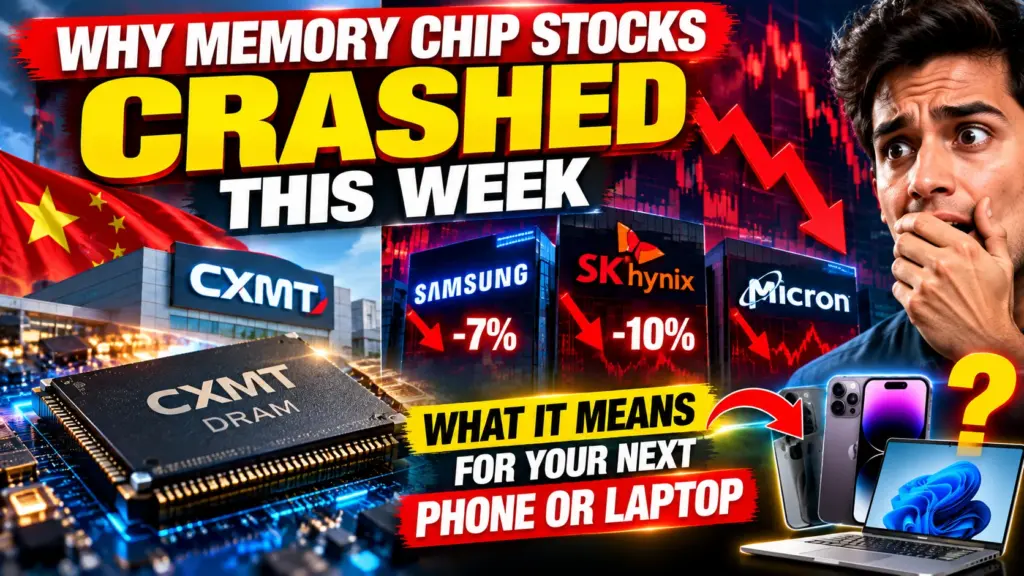
For most of 2026, memory chips have been one of the best trades in the stock market. Micron’s shares were up close to 230% for the year, and Sandisk was up nearly 500%. Then, over a single week in October, a lot of that confidence cracked.
On Monday, October 12, three of the biggest memory chip stocks, Micron, SK Hynix, and Sandisk, lost a combined $108 billion in market value in a single morning. Over a single five-day stretch that week, SK Hynix fell 26%, Samsung dropped 22%, and Micron slid about 11%. The trigger was an announcement from a Chinese company most investors had barely heard of. Here’s what happened, why markets reacted so strongly, and what it could mean for the price of your next phone or laptop.
Inflation Jumped to 3.7% in September.
Social Security Benefits Will Rise 3.6% in 2027.
What Triggered the Memory Chip Selloff
Over the weekend of October 10 and 11, ChangXin Memory Technologies, known as CXMT, announced progress on a new memory-cell design that packs more storage cells onto each chip. CXMT is China’s leading memory maker and a smaller rival to Samsung, SK Hynix, and Micron. It also said it plans to launch a server memory product built on the new design by the end of 2026.
Why would that matter so much? Those three incumbents control roughly 90% of the global market for DRAM, the main type of computer memory. Their profits have surged because AI data centers are buying memory faster than anyone can make it, which has pushed prices to record highs. A credible new competitor, even a distant one, threatens the idea that this shortage keeps profit margins fat for years.

The reaction spread quickly. South Korea’s benchmark index fell sharply as SK Hynix dropped about 10% and Samsung roughly 7% in a single session, extending a five-day losing streak. US memory stocks followed, and the worry spilled into Asian and European tech stocks more broadly.
Was the Reaction Too Big for the News?
Several analysts thought so. Goldman Sachs told clients the fears about China were overdone. Others pointed out that CXMT still trails Samsung, SK Hynix, and Micron in technology and market share, and hasn’t yet shown it can make this new design at large scale. Some of the reporting about its progress also remains unverified.
There’s a geopolitical filter too. Citi analysts noted that the US government is unlikely to allow Chinese-made memory to be sold into the US market, though sales to data centers in places like Europe could still affect Micron indirectly.
So why did stocks fall so hard? Because CXMT’s news landed on an already nervous market. Investors had spent weeks worrying about rising interest rates, about how all this AI spending is being financed, and about whether memory stocks that had climbed so far had gotten ahead of themselves. A Korean business newspaper column about a possible memory oversupply in 2029 added to the unease. A new, more efficient model from the Chinese AI lab DeepSeek then fed fears that AI might need less memory than expected, and Asian chip stocks dropped again at the start of this week. In short, the CXMT news was the spark, but the dry wood was already there.
The Strange Part: Demand Is Still Enormous
Here’s what makes this episode confusing. The business fundamentals haven’t deteriorated. The big memory makers are reportedly sold out of high-bandwidth memory and DRAM through 2027. Micron reported fiscal fourth-quarter revenue of about $54 billion, topping expectations, because of AI data center demand.
That’s the usual pattern with stocks that have run up enormously. When expectations are sky-high, even good news can fail to support the price, while a hint of competition or slowing growth can trigger sharp drops. Market commentators have described this kind of volatility as likely to be the norm for memory stocks going forward: big surges, followed by big pullbacks, even when demand itself remains strong.
What This Means for Phones, Laptops, and Prices
Most readers don’t own Micron stock, but this story connects directly to what you pay for electronics. We’ve covered how the global memory shortage has been squeezing the budget phone market, with sales of phones under $100 collapsing and manufacturers either raising prices or dropping cheap models. It’s also part of the backdrop to why Apple launched a leasing program for iPhones, iPads, and Macs after raising prices on several products.
So could a stronger competitor bring prices down? Eventually, possibly. More supply from another producer tends to ease shortages and lower prices over time. But there are important limits. CXMT’s new product isn’t expected until the end of this year at the earliest, building up manufacturing capacity takes years, and the existing makers say their output is sold out through 2027. A stock market selloff doesn’t change how many memory chips exist this quarter. For consumers, the realistic expectation is that device prices stay elevated for a while, with any relief likely to be gradual and further out, and only if new supply actually arrives or AI demand cools.
The Bigger Picture: AI’s Memory Appetite
It’s also a reminder of how much of the AI boom depends on a few unglamorous components. Memory, networking chips, and power are all constraints on how fast data centers can be built, which connects to deals like Google’s recent custom chip agreement with Marvell and to the fact that AI investment has been carrying a large share of US economic growth this year. When investors start questioning one piece of that chain, it can ripple through the rest quickly, as this week showed.
Memory chip stocks crashed this week because a Chinese rival announced a design breakthrough that raised an uncomfortable question: what if the AI-driven shortage doesn’t last as long, or pay as well, as the market had priced in? The reaction looked bigger than the news itself, and many analysts say CXMT is still years behind, but it landed on a market already worried about rates, AI financing, and sky-high valuations. For everyday buyers, the most important point is that none of this makes your next phone or laptop cheaper tomorrow. Memory is still scarce, and relief, if it comes, will arrive slowly.
Disclaimer:- This article discusses specific publicly traded companies for informational purposes. It is not a recommendation to buy or sell any security.