
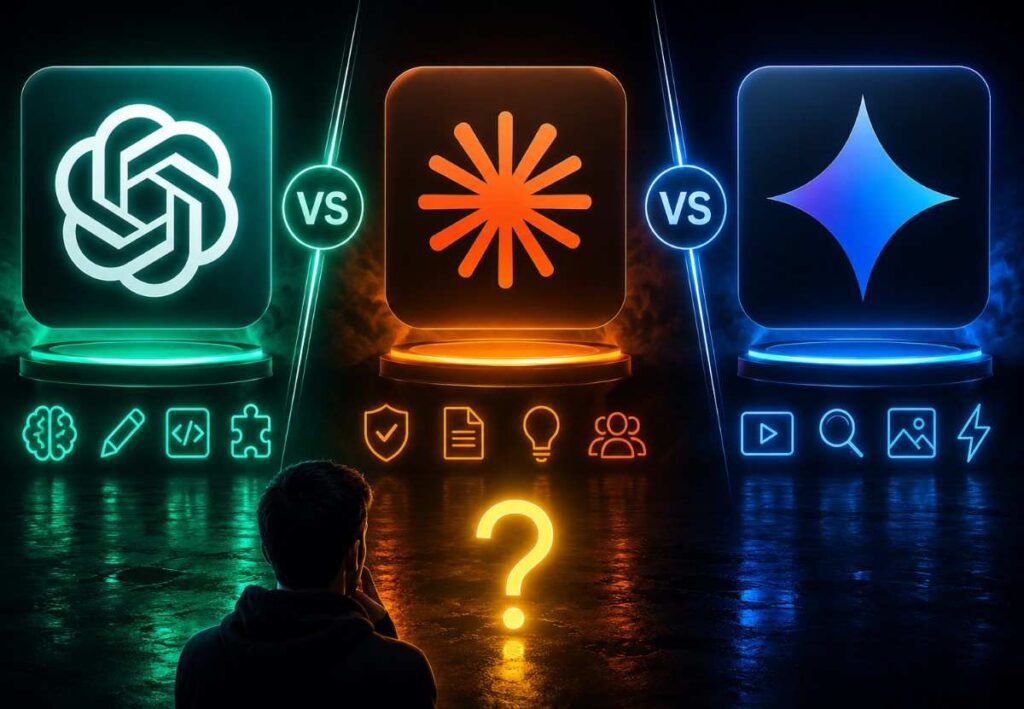
This space moves fast — model names and rankings shift every few weeks. Treat this as a snapshot of where things stand right now, not a permanent verdict.
If you tried to compare these three tools a year ago, the answer might have been simple. That’s not really true anymore. All three companies have shipped multiple new model generations since then, and the honest answer to “which one is best” now depends heavily on what you’re actually trying to do.
Here’s where things actually stand, without the vague “it depends” non-answer most comparison posts settle for.
What’s Actually Running Right Now
The version numbers alone are enough to confuse anyone who isn’t following this closely, so a quick grounding first.
OpenAI’s current flagship is the GPT-5.6 family, released in July, which splits into three tiers: a top-end reasoning model built for the hardest coding and science problems, a balanced everyday option, and a faster, cheaper one for simple tasks. Most people chatting with ChatGPT day to day are still routed to GPT-5.5 by default, with the newer 5.6 tier available for harder reasoning tasks on paid plans.
Anthropic’s lineup includes Claude Sonnet as the everyday workhorse, Claude Opus 4.8 as the higher-capability option favored heavily by developers, and Claude Fable 5, a specialized top-tier model built for long, complex coding and research tasks.
Google’s Gemini 3.1 Pro is still the paid flagship most people are actually using, even though Gemini 3.5 Pro was announced back in May. That launch has slipped more than once, reportedly over coding performance falling short of internal targets, so 3.1 Pro remains the model doing the heavy lifting for now. Gemini 3.5 Flash, the faster and cheaper sibling, is already out and handling a lot of everyday tasks.
None of this is going to look the same by the end of the year. That instability is honestly part of the story here.
Writing: Where the Difference Actually Shows Up Fastest
This is usually the first thing people notice, and it’s the category with the most consistent word-of-mouth pattern across all three tools.
Claude has built a reputation, deserved or not entirely, for producing writing that reads less like it came from a template. Sentence rhythm varies more, it tends to follow detailed formatting instructions closely, and it’s less prone to falling into a recognizable “AI voice.” That reputation is a big part of why so many writers and editors default to it for drafting and editing work.
ChatGPT’s writing has gotten noticeably better across recent versions, but it still leans toward a more structured, occasionally formulaic tone by default, especially for longer pieces. It’s competent and reliable, just often benefits from an editing pass to sound less like an assistant wrote it.
Gemini’s writing quality has improved with the 3.x generation, but user reports are more mixed here than with the other two. It’s solid for straightforward, informational writing. For anything that needs a distinct voice or emotional nuance, it’s usually the third choice, not the first.
Coding: Genuinely Close, Depending on Which Benchmark You Trust
This is the category where the “which one is objectively better” question gets murkiest, because different benchmarks disagree with each other.
On one widely cited coding benchmark, OpenAI’s newest reasoning-tier model edges out Anthropic’s specialized coding model by a narrow margin. On a different benchmark that focuses on real-world software engineering tasks pulled from actual GitHub issues, Anthropic’s model comes out slightly ahead instead. In practice, that gap is small enough that most developers won’t notice a dramatic difference day to day, and workflow integration tends to matter more than the benchmark score.
What does seem consistent across developer surveys and forums is that a large share of professional coders have settled on Claude-based tools as their daily driver, largely because of how well it handles multi-file changes and sticks to instructions across a long task. That’s more of a workflow endorsement than a pure capability claim, but it’s a meaningful signal on its own.
Research and Current Information: This One Isn’t Close Anymore
A year or two ago, this category had a clear winner because only one of these tools had solid, native web search. That’s no longer true. All three now have functional web search built into their standard products, so the old advice that “you can’t ask Claude or ChatGPT about current events” is outdated.
That said, Gemini still has an edge worth mentioning. Its integration with Google’s own search infrastructure tends to be more seamless and thorough, and its scores on complex, current-knowledge reasoning benchmarks are strong. If your work genuinely revolves around live research and fact-heavy work, Gemini is still a reasonable default. But it’s no longer the only option that can pull in today’s news, and the gap has narrowed a lot.
Image Generation and Voice: Still Genuinely One-Sided
Two categories haven’t really changed shape.
If you want an AI tool to generate images directly inside the same conversation, ChatGPT still does this natively and does it well. Claude doesn’t generate images at all, only analyzes and describes them. Gemini has image generation too, though quality and availability vary more by region and plan tier than ChatGPT’s does.
Voice is a similar story. OpenAI has invested heavily here, and its newest conversational voice models are built to listen and respond in real time rather than in a stiff turn-by-turn way. Google has a competing live voice feature that’s solid but less polished. Voice conversation isn’t really Claude’s focus at all right now.
If either of those matters a lot to you, that alone might settle the decision.
Pricing: Still Roughly the Same Ballpark
The headline price for a standard paid plan across all three still lands around $20 a month, which honestly hasn’t moved much despite everything else changing underneath it.
ChatGPT Plus gets you access to the everyday model tier, image generation, voice mode, and a wide plugin ecosystem. Claude Pro gets you the standard model tier, higher usage limits than the free plan, and access to Claude’s coding tools. Google’s AI Pro plan bundles Gemini access with 2TB of storage and deep integration across Gmail, Docs, and Sheets if you’re already living in that ecosystem.
The honest way to think about it: at the same price point, you’re not really choosing based on cost, you’re choosing based on which set of built-in strengths actually matches what you do most days.
So Which One Should You Actually Use
If your day-to-day work is mostly writing, editing, or long documents, Claude tends to require the least cleanup afterward.
If you want one tool that also handles images, voice conversations, and the widest range of plugins and integrations, ChatGPT is the more versatile all-rounder.
If you’re already deep in Google’s ecosystem, or your work depends heavily on having the absolute latest information pulled in reliably, Gemini still earns its place.
And if none of that fully answers it for you, that’s genuinely fine. All three have solid free tiers now, and the gap between free and paid has narrowed enough that a lot of casual users, students especially, can get real value without paying anything at all. Try the free version of whichever one fits your main use case before committing to a subscription. Given how often these rankings shift, that’s probably still true again in three months, just with different specific model names attached to it.