
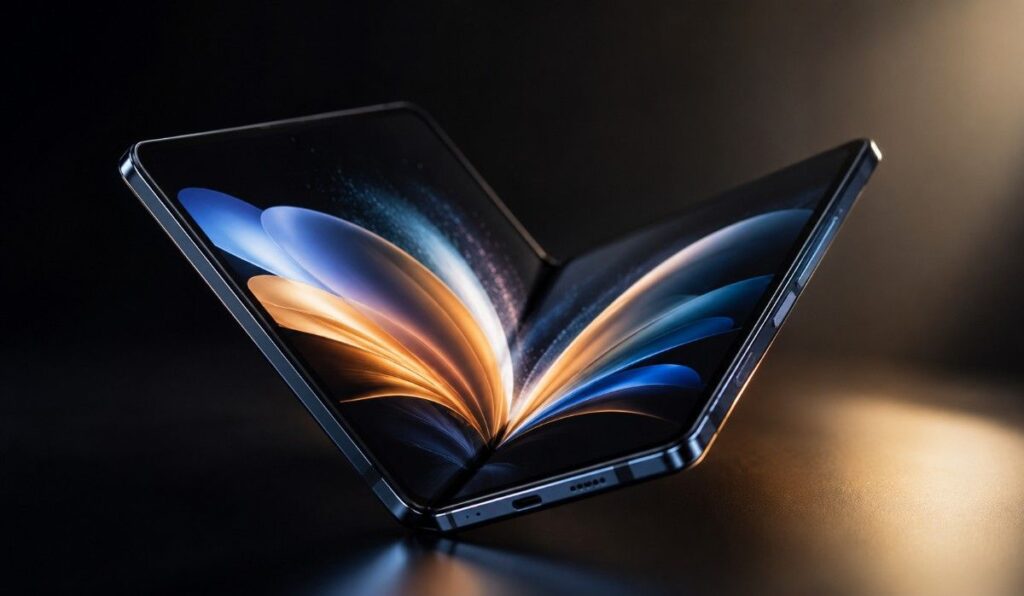
For years, Samsung’s foldable lineup followed a simple logic: one Fold phone, one Flip phone, each getting modest yearly upgrades. That formula just changed. At this year’s Galaxy Unpacked event in London, Samsung introduced a genuine first for the Z series: an “Ultra” foldable, sitting alongside a redesigned standard Fold and the usual Flip.
It’s a small structural shift that says something bigger about where foldables are heading now that the format has matured past its early, gimmicky years.
Two Very Different Foldables, On Purpose
The regular Galaxy Z Fold8 has actually gotten shorter and wider than its predecessors, shifting toward a 4:3 aspect ratio that Samsung is positioning around media consumption and everyday use, things like reading, browsing, and video. It’s also the lightest Fold model Samsung has released, at 201 grams.
The Galaxy Z Fold8 Ultra, meanwhile, is the one aimed at power users. It keeps the taller, more traditional Fold proportions, adds a larger 8-inch main display, and pairs it with upgraded cameras and a bigger battery, all while somehow being the thinnest Z Fold Samsung has ever made, at just 4.1mm when unfolded. Both phones run on the same Snapdragon 8 Elite Gen 5 chip, but the Ultra is clearly the one built for people who use their foldable as a genuine laptop replacement rather than a slightly larger phone.
Splitting the lineup this way is a bet that foldable buyers aren’t one audience anymore. Some people want a foldable mainly for a bigger screen to watch and scroll on. Others want the closest thing to a tablet-and-phone hybrid for actual work. Trying to serve both with a single device was always a compromise, and Samsung’s answer this year is to just stop compromising and build two.
Pricing reflects that split too. The Galaxy Z Fold8 starts at $1,899.99, while the Fold8 Ultra starts higher, at $2,099.99. Both are available for pre-order now, with general sales beginning August 7.
The Watches Got a Quieter, More Interesting Upgrade
Alongside the phones, Samsung refreshed its smartwatch lineup with the Galaxy Watch Ultra2 and Galaxy Watch9. The Ultra2 is the more notable of the two: despite packing a considerably larger 800mAh battery, it’s actually thinner than its predecessor, while keeping its titanium build and rugged, outdoor-sports focus. The Watch9 gets more modest updates, a new chipset, brighter displays, and expanded AI-powered health tracking, and comes in two sizes rather than the single size the Ultra sticks with.
One quiet detail worth noting: Samsung is skipping a Classic model in this year’s watch lineup entirely. Whether that’s a one-year pause or a longer-term shift away from that design remains to be seen.
Not Every Phone Launch This Week Was About Flagship Specs
While Samsung’s event dominated headlines, a few other announcements this week are worth a quick mention, partly because they show how differently companies are approaching the phone market right now.
HMD, the company behind modern Nokia-branded phones, unveiled the Nokia 123 Shield, a genuinely basic feature phone built around durability rather than features. It’s IP68 rated for water and dust resistance, has a removable battery rated for up to 19 days of standby, and costs just €49. In a market saturated with thousand-dollar foldables, there’s something notable about a company still investing in the opposite end of the spectrum entirely, a phone built to survive being dropped in a job site puddle rather than to impress anyone with its display.
On the flagship side, early rumors are already circulating about Apple’s next iPhone, expected to mark the 20th anniversary of the original device. Reports suggest a significantly larger 7-inch screen and a curved display design, though at this stage it’s genuinely just early speculation rather than anything close to confirmed.
Elsewhere, Xiaomi is reportedly planning an earlier-than-usual India launch for its Xiaomi 18 series, while vivo confirmed its X300 E is launching in China this week with a large 7,200mAh battery and a Zeiss-branded camera system, and a gaming-focused iQOO 16T is reportedly being tested with next-generation chipsets, though that launch may not land until sometime next year.
What Actually Matters Here
None of this week’s news changes what phone you should buy tomorrow, but it does say something about where the market’s heading. Samsung splitting its foldable line into distinct “media” and “productivity” versions is a sign the format has moved past proving itself and into actually specializing for different kinds of users, the same maturation regular smartphones went through years ago.
At the same time, a €49 rugged feature phone launching in the same week as a $2,100 foldable is a reminder that the phone market isn’t actually one market. It’s several, moving in genuinely different directions depending on what people are actually trying to solve, whether that’s all-day durability on a job site or a laptop-sized screen that folds into a pocket.