
The pause didn’t last. Iran fired missiles at US forces Wednesday, and oil jumped back up almost as fast as it had fallen. See “The Pause Lasted Four Days” section near the bottom.
Filling up got noticeably more expensive this week. The national average price for a gallon of regular gas crossed $4 on Monday, according to AAA, for only the second time since the war between the US and Iran began disrupting oil markets back in late February.
It’s not the highest gas has been during this conflict. Prices actually spiked well above $4.50 in early May before easing back down once a ceasefire framework briefly took hold in June. But this latest climb matters because it’s happening again, after a stretch where things had genuinely started to calm down.
Why Oil Keeps Reacting to This War
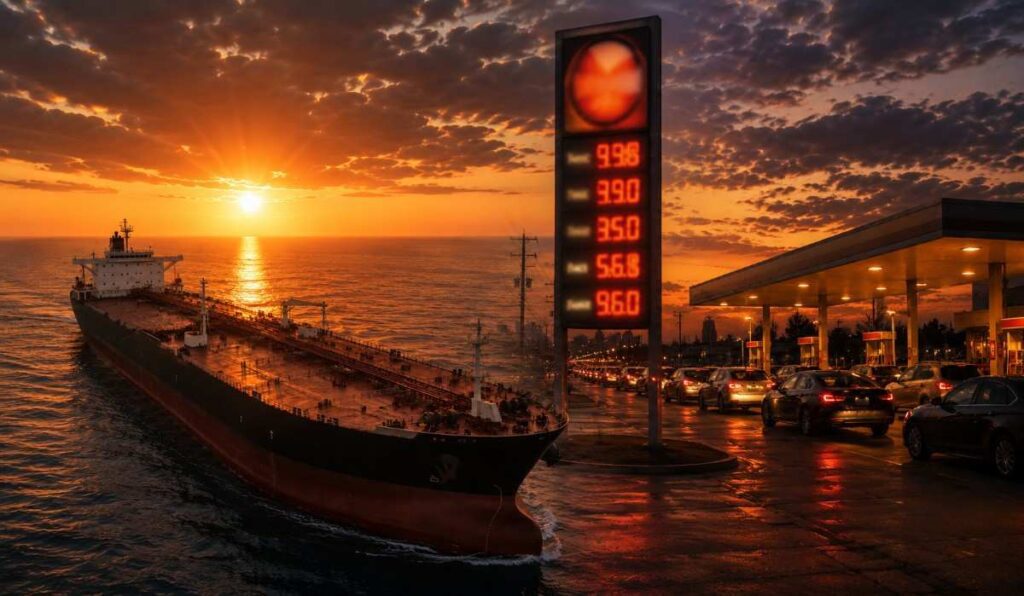
The mechanism here isn’t complicated once you see the pieces. The Strait of Hormuz is a narrow waterway that roughly a fifth of the world’s oil supply normally passes through on its way out of the Persian Gulf. When fighting disrupts traffic there, tanker shipments slow to a crawl, and that scarcity pushes crude oil prices up on global markets almost immediately.
That’s exactly what’s happened over the past week. Brent crude, the international benchmark, briefly touched above $91 a barrel, its highest point since mid-June, before pulling back slightly on renewed hope for diplomacy. US crude followed a similar pattern. Both benchmarks posted their sharpest weekly gains in months as the fighting intensified and ship traffic through the strait all but stopped. Industry data cited by commodities analysts showed only a couple of outbound tankers moving through the strait in recent readings, with essentially no inbound traffic at all.
Gas prices at the pump tend to follow crude oil prices with a short lag, which is why the increase is only now fully showing up at gas stations.
It’s Not Just the War in Iran
The Strait of Hormuz disruption is the biggest single factor, but it’s not acting alone. Attacks on Russian oil refineries tied to the separate Russia-Ukraine conflict have forced Russia into an unusual position, needing to import gasoline itself rather than export it like it normally has for years. That’s tightened the global supply of refined fuel even further, on top of the crude oil squeeze from the Middle East.
Timing hasn’t helped either. This is peak summer driving season in the US, when demand for gas is typically at its highest point of the year regardless of what’s happening overseas. Higher demand layered on top of a tighter supply tends to push prices up faster than either factor would on its own.
A Fragile Diplomatic Track Running Alongside the Fighting
What makes this moment a little different from earlier spikes in the conflict is that active fighting and active diplomacy are happening at the same time, rather than one giving way to the other.
Iranian officials have confirmed receiving ceasefire proposals from multiple international mediators, including a reported push from Qatar for a short-term pause in hostilities. At the same time, US and Iranian forces have continued exchanging strikes, with the US military confirming a ninth consecutive night of operations against Iranian targets as of Monday.
Vice President JD Vance described the current approach as an attempt to work multiple tracks simultaneously, applying pressure through both military and economic means while trying to reach more moderate voices within Iran’s government, all while responding to continued attacks as they happen. He acknowledged there’s no way to know for certain how the situation resolves, but suggested Hormuz has stayed restricted rather than fully closed, which he framed as evidence the situation hasn’t yet spiraled into something far more damaging to global energy supplies.
Whether that assessment holds up over the coming weeks is very much an open question.
What This Means for Regular Drivers
For anyone budgeting around a gas tank, the practical impact is fairly direct. A national average near $4 a gallon means a driver filling a 15-gallon tank is paying somewhere around $10 to $15 more per fill-up than they were a year ago, when the average price was closer to $3.14.
It’s worth remembering that “national average” hides a lot of variation. Drivers on the coasts and in states with higher fuel taxes have been paying well above $4 for a while now, while some interior states remain noticeably lower. Diesel prices have climbed even more sharply in percentage terms, which matters less at the individual pump but tends to ripple into the cost of shipping goods, and eventually into prices at the grocery store and elsewhere.
Whether prices keep climbing from here largely depends on what happens next in the Strait of Hormuz. If shipping through it stays choked off, oil markets are likely to stay jumpy, and gas prices along with them. If the diplomatic track manages to produce something more durable than the ceasefire that briefly held in June, prices have room to ease back down the way they did back then. For now, both outcomes remain firmly on the table.
Update, July 23: A Second Chokepoint Just Opened Up
Things have moved fast since this was first published, and not in the direction anyone hoping for de-escalation wanted.
Brent crude climbed further, touching nearly $98 a barrel on Thursday, its highest level of the entire conflict and up roughly 33% since the war began in February. US crude followed, trading close to $90. The national gas average has risen along with it, now sitting at $4.09 a gallon, up 37% since the war started. Diesel has climbed even further in percentage terms, now above $5.20 a gallon.
The trigger this time isn’t the Strait of Hormuz alone. Yemen’s Houthi militia, which is backed by Iran, claimed missile and drone strikes on two Saudi oil tankers in the Red Sea, following through on a naval blockade the group had threatened days earlier. One of the tankers reportedly caught fire. That waterway, the Bab el-Mandeb Strait at the southern end of the Red Sea, had become an important alternative export route for Saudi Arabia specifically to avoid the risk sitting in the Strait of Hormuz. With that route now under threat too, Saudi Arabia effectively has two major chokepoints to worry about instead of one, and several vessels have already changed course to avoid the area entirely.
The US, for its part, has continued nightly strikes on Iran, with officials confirming a 12th consecutive night of operations. Secretary of State Marco Rubio told reporters the US goal remains preventing Iran from ever developing a nuclear weapon, and said pressure would continue “until they come to their senses” on reaching a deal. He also suggested the Houthis had likely been drawn into the conflict by Iran rather than acting entirely on their own initiative, and expressed hope that piece of the fighting could still de-escalate.
For drivers, the practical math has shifted again. At $4.09 a gallon, filling a 15-gallon tank now costs somewhere around $14 to $19 more than it did a year ago. Whether this latest spike stabilizes or keeps climbing largely depends on whether the Houthi blockade holds, and whether the diplomatic channels still reportedly open behind the scenes manage to produce anything before oil markets push toward that symbolic $100 mark.
Update, July 27: Ceasefire, Again
Oil markets got the answer to that question, at least for now, and it wasn’t more escalation.
Brent crude briefly touched $102 a barrel last week, the highest point of the entire conflict, before the US and Iran both pulled back over the weekend. The US military paused its bombing campaign after 13 consecutive nights of strikes, and Iran said it would halt retaliatory attacks against US allies in the region as long as the pause held on the American side. The result was one of the sharpest single-day oil moves of the whole war: Brent dropped as much as 7% at one point Monday, falling below $90 a barrel before settling back near $91 to $92. US crude fell a similar amount, trading around $84 to $85.
The dollar weakened alongside the drop in oil, and stocks and gold both gained as investors treated the pause as a genuine, if fragile, de-escalation signal rather than another brief lull.
Trump’s UN ambassador described the move as giving negotiations “a little bit of room,” while stressing that US forces remained ready to resume strikes if needed. Reporting since has suggested the pause followed internal concerns that the military was running low on viable targets after two weeks of near-nightly bombing, alongside a China-led push to revive diplomatic talks that had stalled. Iranian officials, for their part, framed their own halt as directly conditional: their retaliatory strikes stop only as long as the American ones do.
That conditional structure is worth sitting with. This isn’t a signed ceasefire agreement, it’s more like both sides agreeing to stop for now, with no real guarantee either side keeps holding. The April ceasefire that this same conflict broke in the first place looked stable for a while too, before the Strait of Hormuz fighting reignited it. Shipping data is telling a similarly cautious story: traffic through the Strait of Hormuz stayed low over the weekend even after the pause began, and Bab el-Mandeb traffic in the Red Sea actually hit its lowest level in months after the Houthi attacks on Saudi tankers earlier in the week.
For drivers, a pause in fighting doesn’t undo the price increases already sitting at the pump, but it does reduce the immediate pressure pushing prices higher. Whether gas prices actually come down meaningfully from here depends less on this weekend’s news and more on whether this pause turns into something that holds for weeks rather than days.
Update, July 29: The Pause Lasted Four Days
It didn’t hold for weeks. It barely held for four days.
Late Tuesday, Iran’s Revolutionary Guard Corps launched multiple ballistic missiles at US forces in the Middle East in what US Central Command described as a surprise attack. Every missile was intercepted, and no US positions were hit, but the attack itself was enough to end the brief pause. Hours later, CENTCOM confirmed that US and Saudi forces had carried out strikes against what they described as Iran-backed militia sites in eastern Iraq, retaliating for a string of more than 30 drone attacks over the preceding three days aimed at Saudi oil infrastructure. Saudi Arabia said it had separately intercepted drones targeting its own petroleum facilities in the days leading up to the strikes.
Oil reacted almost immediately. Brent crude, which had tumbled roughly 8% during the brief pause, jumped back up around 4%, trading near $88 a barrel. US crude followed the same pattern, rising a similar amount to around $82 to $83. The reversal recovered a meaningful chunk of the ground oil had just given up, though prices remain below the roughly $102 peak hit before the pause began.
Adding to the upward pressure, US crude inventories fell again last week, a bullish signal for prices independent of anything happening geopolitically, while the government’s emergency petroleum reserve dropped to its lowest level since 1983 after another release.
The whiplash here is really the story. Oil fell sharply on hope, then rose sharply the moment that hope looked premature, all within the space of about four trading days. That kind of swing has become the defining pattern of this conflict rather than the exception: a pause creates real, measurable relief in prices, and a single incident, intercepted or not, erases a meaningful chunk of it almost overnight.
For drivers, the practical takeaway hasn’t really changed, just intensified. Gas prices had already climbed back toward $4 a gallon before this latest flare-up, and a reignited conflict makes it more likely that level holds or climbs further rather than easing off. Anyone hoping for a clean, steady decline in prices is watching a market that, five months into this war, still hasn’t given them one.