
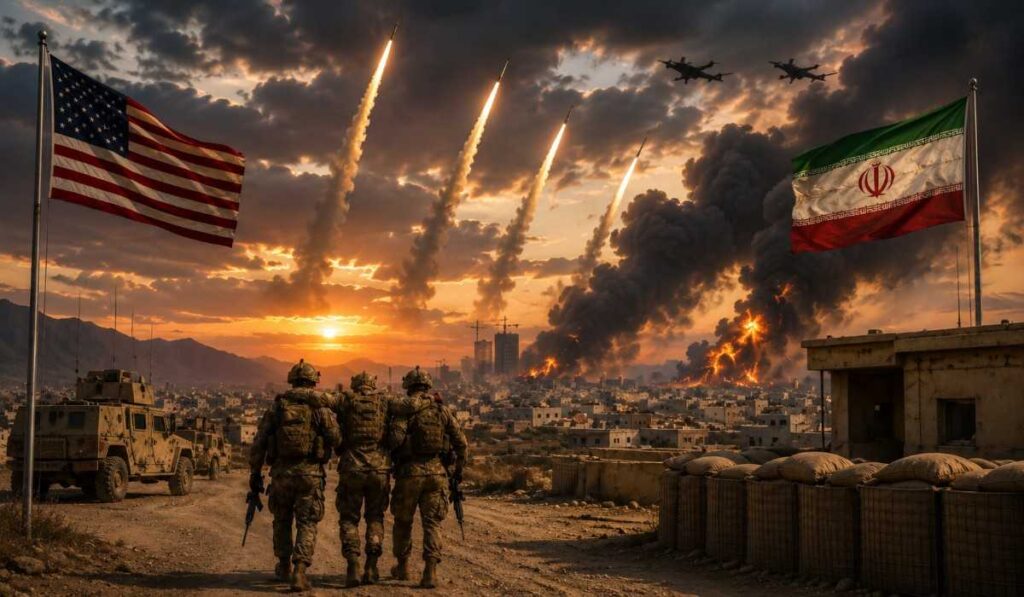
The pause lasted four days. Iran fired ballistic missiles at US forces Tuesday, all intercepted, and the US and Saudi Arabia struck back in Iraq. See “The Pause Lasted Four Days” at the bottom for the latest.
Two American service members are dead and a third is missing after Iran struck a US base in Jordan on Friday. Within a day, the US had already hit back.
US Central Command confirmed it launched new airstrikes against Iran on Saturday evening, describing the response as a way to punish the forces responsible while also degrading Iran’s ability to keep threatening shipping through the Strait of Hormuz. It’s the eighth straight day of American combat operations against Iran, and the deaths in Jordan mark the first direct US combat fatalities from Iranian fire since March.
Here’s how things got to this point, and why it matters well beyond the two countries directly involved.
A War That’s Been Building Since February
The current conflict traces back to February 28, when Iran launched a wave of drone and missile strikes against American and allied military sites across the Middle East. Since then, fighting has continued in fits and starts, occasionally cooling off, then flaring back up.
One of those cooling-off periods came in June, when Washington and Tehran reached a framework agreement. Part of the deal involved Iran managing safe passage for commercial ships through the Strait of Hormuz, a narrow but critical waterway that a huge share of the world’s oil shipments pass through.
That arrangement didn’t hold. Attacks on commercial vessels in the strait resumed in early July, and while Iranian officials didn’t publicly claim responsibility for every incident, both Gulf nations and the US pointed to Iran. On July 11, an Indian sailor was killed when Iran’s Revolutionary Guard Corps struck a ship it said had used an unauthorized route. Iran then declared the strait closed until the US ended its military involvement in the region, and the US resumed near-daily strikes shortly after.
Why Jordan Changes the Picture
Jordan hadn’t been a central battleground in this war up to this point. It’s a longtime American security partner, not one of the Gulf states that’s been absorbing most of the fighting.
Friday’s strike hit a US base there directly, killing two service members and leaving a third unaccounted for. Four more troops were hospitalized and later discharged. It brings the total American death toll since February to 16, with several hundred more wounded over the course of the conflict.
The fact that Iran reached into Jordan signals the war’s geography is widening, not narrowing. Similar strikes have hit US positions in Bahrain and Kuwait in recent days, and Kuwaiti officials say attacks have started targeting desalination plants, a critical source of drinking water in a region where fresh water is already scarce. Iran, for its part, said a US strike hit a desalination facility near the city of Jask over the weekend.
This Isn’t the First Time Jordan Has Been Hit
There’s an uncomfortable parallel here for anyone who’s followed US-Iran tensions over the past couple of years. Back in January 2024, an Iran-backed militia struck a US outpost known as Tower 22 in northeastern Jordan, killing three American soldiers and wounding dozens more. That attack happened during a different, narrower phase of tension tied to the Israel-Hamas war, and it didn’t immediately spiral into the kind of sustained, direct state-on-state conflict that’s playing out now.
This time is different in a few important ways. The current war isn’t being fought through proxy militias operating with some deniability, it’s a direct exchange between American and Iranian forces that’s been going on for months. And unlike the 2024 incident, which prompted a set of retaliatory strikes and then a relative calm, this latest attack lands in the middle of an already active daily exchange of fire. There’s less room for either side to treat it as an isolated incident.
What This Means If You’re Not in the Middle East
It’s easy to see a story like this and assume it’s a regional issue that doesn’t reach much further. That’s not really true here.
The Strait of Hormuz carries a massive share of the world’s oil supply. Sustained disruption to shipping through it tends to push oil prices up globally, which eventually shows up at the gas pump, in shipping costs, and in the price of goods that depend on that fuel to get where they’re going. The longer the strait stays contested, the more that risk builds.
There’s also a broader question hanging over the conflict now. Casualties on the American side had been relatively limited for months, mostly tied to indirect incidents rather than direct hits. Two confirmed combat deaths from direct Iranian fire changes the political weight of the war domestically, and it’s likely to shape how much appetite there is in Washington for continuing, or escalating, the current approach.
Neither side has signaled it’s backing down. Iran has warned of a larger response if strikes continue, and the US has kept up daily operations against Iranian targets, including recent strikes on bridges and power infrastructure. Whether this settles into another uneasy pause, like the one in June, or keeps widening, is the question that will shape the next stretch of this conflict.
What to Watch Next
That question has already started answering itself.
Since this story first broke, the conflict has expanded to a second front. Yemen’s Houthi militia, backed by Iran, declared a naval blockade on Saudi-linked shipping and followed through days later, claiming missile and drone strikes on two Saudi oil tankers in the Red Sea. One reportedly caught fire. That waterway, the Bab el-Mandeb Strait, had become Saudi Arabia’s main alternative for exporting oil while avoiding the contested Strait of Hormuz. With Houthi forces now threatening that route too, Saudi Arabia is effectively boxed in on two sides, and several vessels have already diverted away from the area entirely.
Oil has responded accordingly. Brent crude climbed to nearly $98 a barrel, its highest point of the entire war and up roughly a third since fighting began in February. The US has kept up its strikes on Iran throughout, confirming a 12th consecutive night of operations as of this week.
Secretary of State Marco Rubio, addressing reporters, framed the US position plainly: the core goal remains ensuring Iran can never build a nuclear weapon, and pressure will continue until Tehran is “serious about making a deal.” He also suggested the Houthis had likely been pulled into the fight by Iran rather than acting purely on their own, adding he hoped that particular front could still cool down even as the broader war continues.
Oman, which has a long history of mediating between Saudi Arabia and Yemen’s Houthi movement, said it’s working with Saudi officials, Yemeni groups, and the UN’s envoy to Yemen to try to walk this specific escalation back. Whether that effort gains traction before oil prices push past the symbolic $100 mark, or whether the war keeps finding new fronts to spread into, is the question hanging over the next several days.
A Pause, Not a Peace Deal
That question, at least for the moment, has an answer, and it’s a more hopeful one than the trajectory this story had been on.
Oil briefly touched $102 a barrel last week, its highest point of the entire five-month war, before both the US and Iran pulled back. The US military paused its bombing campaign after 13 consecutive nights of strikes, the longest sustained run since the war reignited. Iran said it would halt retaliatory attacks against US allies in the region as long as the American pause held. Trump’s UN ambassador told reporters the president was giving negotiations “a little bit of room,” while stressing that US forces remained ready to resume strikes if talks fail.
Reporting since the pause began suggests part of what drove the decision was practical: advisers reportedly raised concerns that the military was running low on viable targets after two weeks of near-nightly bombing. The pause also follows a renewed diplomatic push led by China to bring both sides back to the table, with talks reportedly taking place in Pakistan.
It’s worth being clear-eyed about what this pause actually is. It’s not a signed ceasefire, and it’s explicitly conditional, Iran’s army spokesman described it as retaliatory strikes stopping only because the American ones stopped first. The April ceasefire that this same war broke also looked stable for a while before the Strait of Hormuz fighting reignited everything. Shipping data reflects that same caution: traffic through Hormuz stayed low over the weekend even after the pause began, and Bab el-Mandeb traffic in the Red Sea hit its lowest level in months following the Houthi attacks on Saudi tankers earlier in the week.
Markets reacted immediately regardless. Oil dropped as much as 7% at one point, one of the sharpest single-day moves of the entire conflict, and the dollar weakened as investors treated the pause as a genuine, if fragile, signal rather than another brief lull. Whether it turns into something more durable than that depends entirely on whether both sides actually hold their fire long enough for the diplomatic track to produce something real.
The Pause Lasted Four Days
It didn’t.
Late Tuesday, US Central Command said Iran’s Revolutionary Guard Corps launched multiple ballistic missiles at US forces in the Middle East in what it described as an attempted surprise attack. Every missile was intercepted, and CENTCOM said no US positions were hit, though it didn’t specify which bases were targeted. Axios reported, citing US officials, that the attack was directed at the American base in Jordan, the same country where the war’s first direct US combat deaths occurred back in July.
The response came within hours. CENTCOM confirmed that US and Saudi forces carried out strikes against what they described as multiple terrorist logistics and weapons sites in eastern Iraq, retaliating against more than 30 drone attacks over the preceding three days by Iran-aligned groups. Saudi Arabia’s defense ministry said it had separately intercepted several drones aimed at petroleum facilities in the kingdom’s eastern region in the days before the strikes, and stressed the joint action was defensive rather than an attempt to escalate further. Separately, UK maritime authorities reported an explosion heard by a tanker crew transiting the southern Red Sea, though details remained limited.
Iran’s government hadn’t publicly confirmed or explained the missile attack as of this writing.
The practical effect was immediate and measurable. Oil, which had fallen roughly 8% during the brief pause, reversed sharply, with Brent crude jumping back up around 4% to trade near $88 a barrel. That’s a meaningful recovery from the pause-driven lows, though still below the roughly $102 peak hit just before the ceasefire began.
Five months into this war, the pattern is becoming the story in its own right: pauses create real, measurable relief, and a single incident, intercepted or not, tends to erase a significant chunk of that relief within hours. Whether this particular flare-up settles back into another lull or marks a return to sustained fighting is, at this point, a question this conflict has asked and answered in both directions more than once already.