
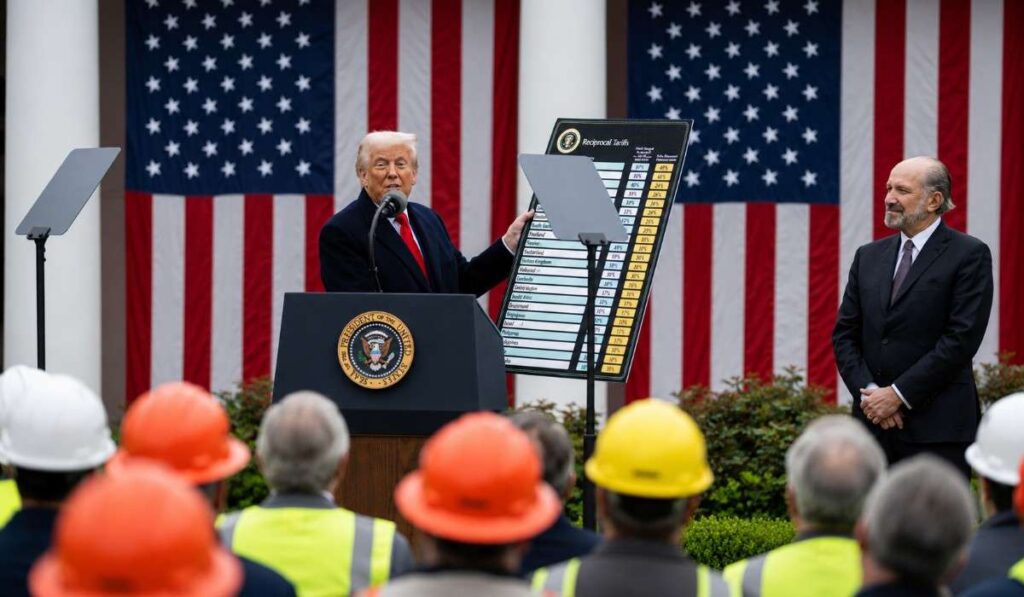
If you’ve lost track of how many times Trump’s tariffs have ended up in court this year, that’s understandable. This is round three, and it’s arguably the most sweeping version yet.
Two groups of small businesses filed lawsuits this week challenging a new round of tariffs that impose double-digit levies on goods from 60 trading partners, covering roughly 99% of everything the US imports. The timing isn’t a coincidence. The new tariffs landed just as a previous, temporary 10% global tariff expired, one that had also been tied up in its own legal challenge.
How We Actually Got Here
Following this requires a bit of a timeline, so here’s the short version.
Back in February, the Supreme Court struck down an earlier, broad set of tariffs that the administration had imposed under the International Emergency Economic Powers Act, ruling that law didn’t give the president authority to unilaterally set tariffs at that scale. That was a real defeat for the administration’s trade strategy, and a win for the businesses and legal groups that had challenged it.
The response wasn’t to abandon the approach, it was to find a different legal basis for something similar. The administration turned to Section 122 of the Trade Act of 1974, which allows for temporary tariffs during specific balance-of-payments emergencies, and used it to reintroduce global tariffs, this time at 10%. That version also drew a legal challenge almost immediately, with critics arguing that a standard trade deficit doesn’t meet the kind of emergency the law was actually written for.
Now that 10% tariff has expired, and it’s been replaced by something considerably broader. The new tariffs rely on yet another legal mechanism, Section 301 of the Trade Act, which the administration says targets countries that have failed to prevent goods made with forced labor from entering the US. Critics see it differently: as a way to functionally replace the tariffs the Supreme Court just struck down, using a new statute instead of a new justification.
- Apple HomeView Explained: The $299 Smart Display, the New Siri AI, and Who Should Wait
- The 2027 401(k) Contribution Limit Is Projected at $25,500. Here’s What’s Confirmed, What’s Not, and How to Plan
- Trump’s Russian Diesel Deal, Explained: What Was Agreed, Why Congress Is Angry, and Whether It Will Lower Prices
- Why Memory Chip Stocks Crashed This Week, and What It Means for Your Next Phone or Laptop
- Inflation Jumped to 3.7% in September. Here’s What the Hot CPI Report Means for the Fed, Your Mortgage, and Your Wallet
The Businesses Pushing Back
The lawsuits come from a mix of small companies that import goods internationally, groups small enough that even modest tariff increases can meaningfully affect their bottom line.
One case includes a company that was part of the earlier lawsuit that succeeded at the Supreme Court, along with several other small businesses, filed through the Court of International Trade. A separate suit comes from a New York-based spice importer and a California watch retailer, represented by the Liberty Justice Center, the advocacy group that’s now been involved in each round of this fight.
Their core argument isn’t that forced labor is an acceptable trade practice, both filings are careful to say the opposite. It’s that the administration hasn’t adequately shown, country by country, that the specific legal conditions required under Section 301 have actually been met, or explained how a broad tariff is supposed to eliminate the practice it’s meant to punish.
Why This Round Might Be Harder to Challenge
Legal observers following the case have pointed out something worth understanding: Section 301 is a meaningfully different legal tool than the ones used in the previous two rounds, and it may hold up better in court.
Unlike IEEPA, which the Supreme Court found didn’t give the president this kind of tariff authority at all, Section 301 does explicitly authorize the president to impose tariffs in response to unfair trade practices, forced labor among them. That means this fight isn’t really about whether the president has the power to act under this specific law, it’s about whether the administration followed the law’s own requirements closely enough in how it applied that power. That’s a narrower, and often harder, argument to win than the one that succeeded in February.
Why This Matters Beyond the Courtroom
Tariffs covering 99% of imports is about as broad as this kind of policy gets, and the practical effect shows up well beyond the businesses directly suing over it.
Tariffs function as a tax on imported goods, and that cost typically gets passed along, at least partially, to the businesses buying those goods and eventually to consumers paying for them. A small spice importer or a watch retailer facing a sudden double-digit cost increase on inventory either absorbs that cost, raises prices, or scales back what it imports altogether. Multiply that across thousands of small businesses covering nearly all categories of imported goods, and the aggregate effect on prices is the kind of thing that shows up gradually in everyday costs rather than all at once.
It’s also part of a broader pattern worth watching. Whatever happens with this specific case, this is now the third time in under a year that sweeping tariffs have been challenged in court almost immediately after being announced. That back-and-forth, tariffs announced, challenged, sometimes struck down, then reintroduced under a different legal justification, has itself become a source of uncertainty for businesses trying to plan inventory and pricing months in advance, separate from whatever the tariffs themselves end up costing.
The Court of International Trade will need to weigh in before any of this is resolved, and given how the last two rounds played out, an appeal to higher courts wouldn’t be surprising regardless of which way this one goes.