
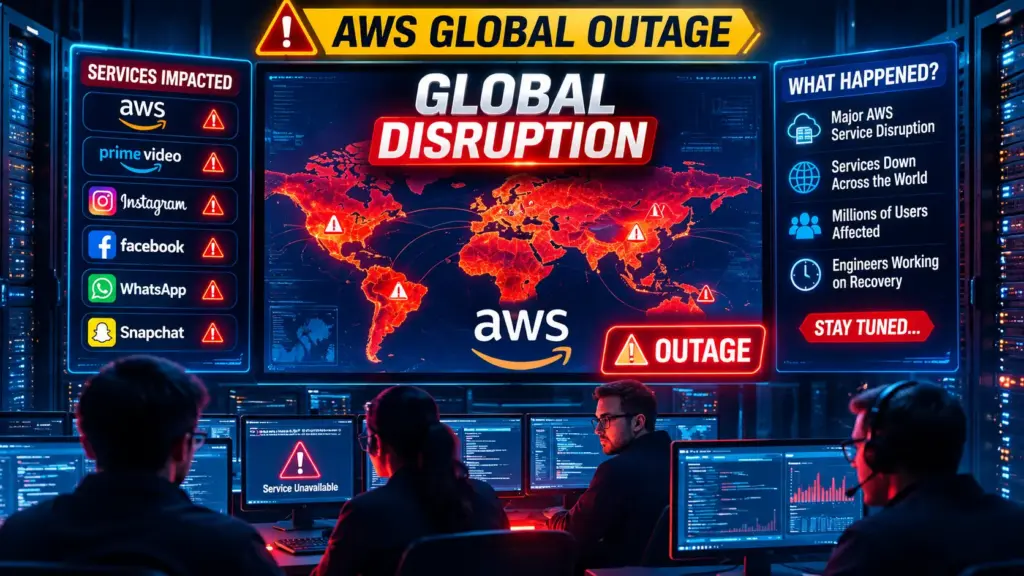
If it feels like you’ve read a headline about a major internet outage more often than usual this year, that’s not a coincidence. Amazon Web Services, the cloud infrastructure quietly running a huge share of the websites and apps people use daily, has now suffered five notable outages in 2026 alone, most recently a partial outage on August 15 tied to a connectivity issue at a data center in Frankfurt, Germany.
None of these individually made for the kind of chaos the internet saw in October 2025, when a single AWS failure knocked out ChatGPT, Snapchat, Coinbase, and thousands of other services simultaneously. But taken together, this year’s pattern raises a more uncomfortable question than any single outage does: why does one company’s infrastructure problems keep becoming everyone else’s problem too?
This Year’s Outages, One After Another
The pattern started in March, when a genuinely unusual event, a physical fire triggered by an object striking a data center in AWS’s UAE region, forced emergency shutdowns that cascaded into AWS’s Bahrain region and caused service degradation as far away as the Americas. That wasn’t a software bug. It was actual infrastructure damage, and it knocked out 38 services in one region and 46 in another.
May brought a different kind of failure entirely: overheating inside a single Northern Virginia data center caused instances to fail after backup cooling systems couldn’t keep pace, part of AWS’s most heavily used global region. June added a network disruption that reportedly touched Cloudflare as well, showing how failures can hop between providers that are supposed to be independent backups for each other.

July 24 brought a connectivity issue centered on AWS’s US-WEST-2 region in Oregon, knocking out Apple Pay, DoorDash, Reddit, Hulu, and PlayStation Network for roughly 80 minutes. Barely two weeks later, in early August, a strikingly similar connectivity problem hit the same US-WEST-2 region again, this time traced to the same network path connecting to Seattle. AWS hasn’t said publicly whether the two incidents share a root cause or are coincidentally similar failures on the same stretch of infrastructure.
And now, the most recent incident: a partial outage beginning August 15, tied to a co-location partner’s facility in Frankfurt, still showing lingering effects days later according to independent status trackers, a slower, quieter incident than some of the year’s other failures, but one more entry in a year that already has an unusually long list.
Why One Company’s Bad Week Becomes Everyone’s Bad Week
The mechanism behind all of this isn’t complicated, even if the individual technical failures are. A huge share of the modern internet doesn’t run on companies’ own servers anymore. It runs on a small handful of cloud providers, AWS, Microsoft Azure, and Google Cloud chief among them, who lease out computing power, storage, and networking to essentially everyone else.
That arrangement makes obvious sense most of the time. Renting infrastructure from a company that’s spent billions perfecting it is usually more reliable and far cheaper than any individual business building its own data centers from scratch. The tradeoff is concentration risk. When a huge percentage of the internet’s actual plumbing runs through the same handful of providers, and often the same specific regions within those providers, a failure in one place stops being that one company’s problem and starts being a shared failure across every business that happens to be renting space in the same digital building.
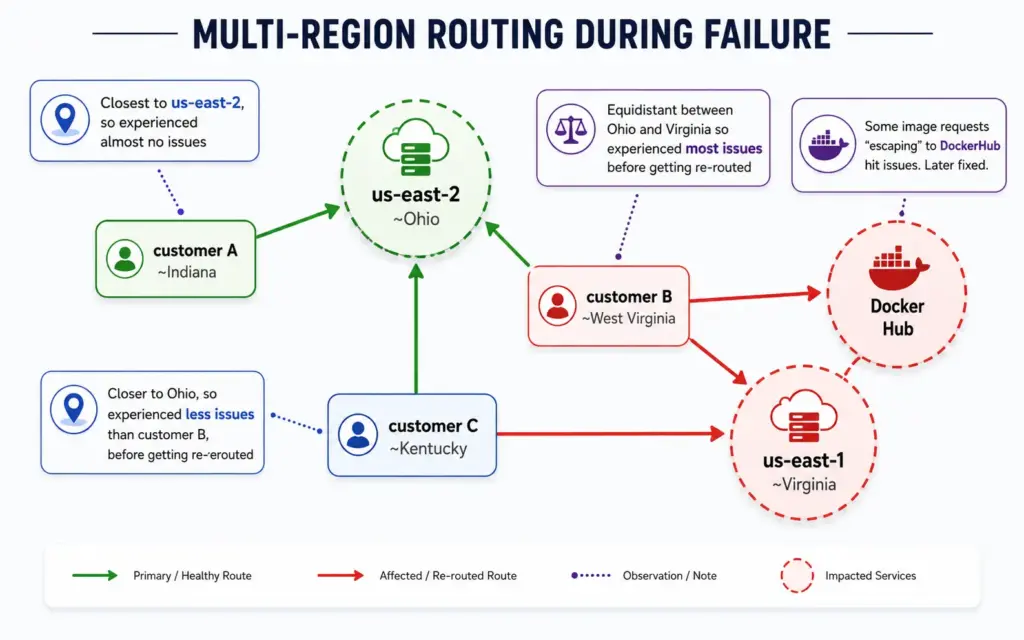
AWS’s US-EAST-1 region in Northern Virginia is a particularly extreme example of this concentration. It’s AWS’s oldest, largest, and most heavily used region globally, which means outages there tend to have outsized effects simply because so much of the internet has chosen to run through it, often without realizing how much company they’re keeping.
What Businesses Are Actually Supposed to Do About This
The theoretical fix isn’t a secret. Companies can run redundant infrastructure across multiple regions, or even multiple cloud providers entirely, so that a failure in one place doesn’t take the whole operation down. Some large enterprises already do exactly this.
The catch is cost and complexity. Running duplicate infrastructure across regions or providers roughly doubles a company’s cloud spending and adds real engineering overhead to keep everything properly synchronized. For large, well-resourced companies, that tradeoff often makes sense. For smaller businesses and startups, and there are a lot more of those than there are tech giants, it frequently doesn’t, at least not until an outage makes the cost of downtime suddenly feel a lot more real than the cost of redundancy.
Why This Pattern Matters Beyond Tech Headlines
Five notable outages in under eight months isn’t necessarily a sign that AWS’s infrastructure is fundamentally deteriorating, cloud providers operate infrastructure at a scale where some rate of failure is close to statistically inevitable. But it is a useful, recurring reminder of something easy to forget when everything’s working normally: the modern internet’s reliability rests on a surprisingly small number of load-bearing pillars.
As AI infrastructure spending accelerates, and data centers become an even larger, more central part of the economy, that concentration isn’t shrinking. It’s growing. Whether 2026 ends up remembered as an unusually rough year for cloud reliability, or the year the pattern became the new normal, is a question that probably won’t have a clear answer until we’re well into whatever comes after it.

