
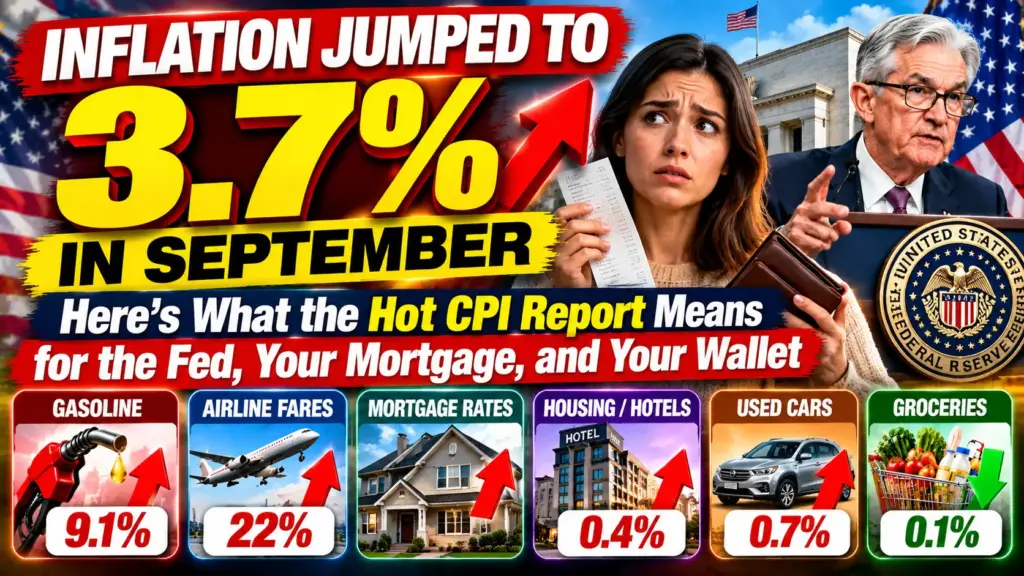
Prices rose faster than expected last month. The September CPI report, released Wednesday by the Bureau of Labor Statistics, showed inflation climbing to 3.7% over the past year, up from 3.4% in August and above the 3.6% economists had forecast. Prices rose 0.6% from August alone.
The headline driver was gasoline, which jumped 9.1% in a single month. But the report also had an uncomfortable detail for the Federal Reserve: the pressure wasn’t limited to the pump. Here’s what the numbers actually say, why they matter for interest rates, and what they mean for your budget.
Social Security Benefits Will Rise 3.6% in 2027.
AI Could Cut Demand for 36 Million US Jobs by 2035.
What the September CPI Report Actually Showed
The Consumer Price Index measures how much more it costs to buy the same basket of goods and services than it did a year earlier. The key readings from the report:
- Headline inflation: 3.7% year over year, up from 3.4% in August.
- Monthly change: 0.6% in September, after 0.4% in August.
- Core inflation (excluding food and energy): 2.6% year over year, up from 2.4%, and 0.3% for the month, a tick hotter than forecast.
- Gasoline: up 9.1% in September, after a 3.9% rise in August, and responsible for more than half of the month’s increase.
- Airline fares: up 1.2% on the month and about 22% from a year ago, mostly because of higher jet fuel costs.
- Shelter: up 0.4% on the month, with hotel prices rising too.
- Used cars and trucks: up 0.7%.
- Food: flat on the month and up 2.5% from a year ago, with grocery prices actually slipping 0.1%.
That last line is a useful reminder that “inflation” isn’t one number felt equally everywhere. Grocery bills were calm in September while fuel and travel costs surged.
Why Inflation Jumped, and Why It Wasn’t Just Gas
The easy explanation is energy. Gas prices have been above $4 a gallon on a record number of days this year because of the war with Iran, and September’s spike pushed the headline number higher. That’s real, and it’s the biggest single piece of the story.
What worried economists more was the core reading, which strips out food and energy to show underlying price pressure. Core inflation rose to 2.6% and beat forecasts, and several analysts noted the surprise was broad-based rather than a one-off. Shelter costs, used cars, and travel-related categories all contributed. One strategist pointed out that core prices ran at roughly a 3.7% annualized pace in September, well above the Fed’s 2% goal.
Economists cited by CNBC also pointed to other forces pushing prices up: tariffs, the construction boom for AI data centers, and strong consumer demand in categories like travel. Taken together, it adds up to an economy where costs are rising from several directions at once, not just one.
What Is Core CPI, and Why Does the Fed Care?
Headline CPI is the total inflation rate households experience, including volatile food and energy prices. Core CPI leaves those out. Because gas and groceries can swing wildly from month to month for reasons unrelated to the broader economy, the Fed looks at core inflation to judge whether price increases are becoming entrenched.
That’s why the core surprise mattered more than the headline number to markets. A spike driven only by gasoline can fade if oil prices fall. A rise that shows up in rent, services, and goods is harder to ignore, and it’s the kind of thing that pushes the Fed toward higher interest rates.
Will the Fed Raise Rates in October or December?
The Fed already moved once. On September 16, it raised its benchmark rate by a quarter point to a range of 3.75% to 4.00%, its first hike in three years, in a unanimous vote, and signaled more increases could follow. Its next decision comes October 28.
What happened to expectations after the CPI report shows how jumpy this is. Traders briefly priced roughly even odds of a hike at the October meeting, up from about 20% before the report. Then Fed Chair Kevin Warsh spoke at the International Monetary Fund meetings in Bangkok and gave no signal that a move was imminent, and the odds dropped back to around 15% to 17% by Friday. A December hike, meanwhile, is priced at close to 90%.
Other data this week pointed the same way. Wholesale prices jumped 1.3% in September, the largest monthly rise since early 2022, and 6.3% from a year earlier, a four-year high. Retail sales rose 0.8%, showing consumers are still spending. Analysts at Wells Fargo Investment Institute expect the Fed to keep raising rates between now and spring 2027. The market odds will keep moving with every new data point, so treat any specific probability as a snapshot, not a forecast.
What Higher Inflation and Rate Hikes Mean for Your Money
A few practical effects are worth understanding, even if you never follow the Fed closely.
Credit cards and variable-rate debt. These respond fastest to Fed hikes. If you carry a balance, rates on cards and some adjustable loans tend to rise within a billing cycle or two after the Fed acts.
Mortgages. Mortgage rates track longer-term Treasury yields more than the Fed’s own rate, but a hotter inflation report pushes those yields up, which is exactly what happened after the CPI release. Our breakdown of Treasury yields and mortgage rates explains the link in more detail.
Savings. Higher rates are the one upside. A high-yield savings account usually passes through at least part of any Fed increase, so yields on cash tend to creep up when the Fed hikes. It’s worth checking whether your savings rate is keeping pace.
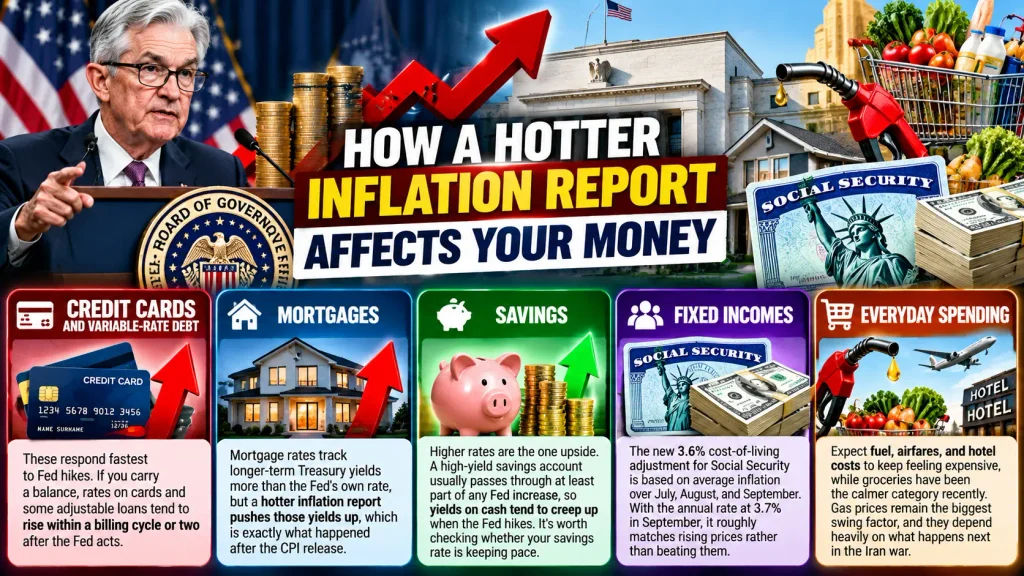
Fixed incomes. The new 3.6% cost-of-living adjustment for Social Security is based on average inflation over July, August, and September. With the annual rate at 3.7% in September, it roughly matches rising prices rather than beating them.
Everyday spending. Expect fuel, airfares, and hotel costs to keep feeling expensive, while groceries have been the calmer category recently. Gas prices remain the biggest swing factor, and they depend heavily on what happens next in the Iran war.
Should You Sell Stocks Because of Inflation?
Markets did react badly: the S&P 500 fell about 1.1% on the day of the report, and Treasury yields jumped. It’s natural to wonder whether this is the time to get out.
Historical data offers some perspective, with caveats. A Motley Fool analysis of inflation and stock returns since 1950 found that the S&P 500 rose over the following year after roughly 69% of months when inflation was at 3.5% or higher, compared with about 79% after months when inflation was below 3%. In other words, hot inflation has made stocks somewhat less likely to rise, but it has not usually meant a falling market. Past performance doesn’t predict the future, and every inflation episode has had its own causes. The more useful takeaway is that a single hot report is rarely a reason, by itself, to overhaul a long-term plan.
The Bottom Line
The September CPI report showed inflation at 3.7%, led by a 9.1% jump in gasoline but supported by firmer core prices across shelter, used cars, and travel. That combination keeps the Federal Reserve leaning toward more rate hikes, with a December increase widely expected. For households, the practical effects are higher costs on variable-rate debt, pressure on mortgage rates, slightly better returns on savings, and a budget that feels most strained at the pump and the airport. The next big checkpoints are the Fed’s October 28 decision and the October CPI report in mid-November, and both are likely to move expectations again.
Disclaimer:- General information only, not personalized financial or investment advice.

