
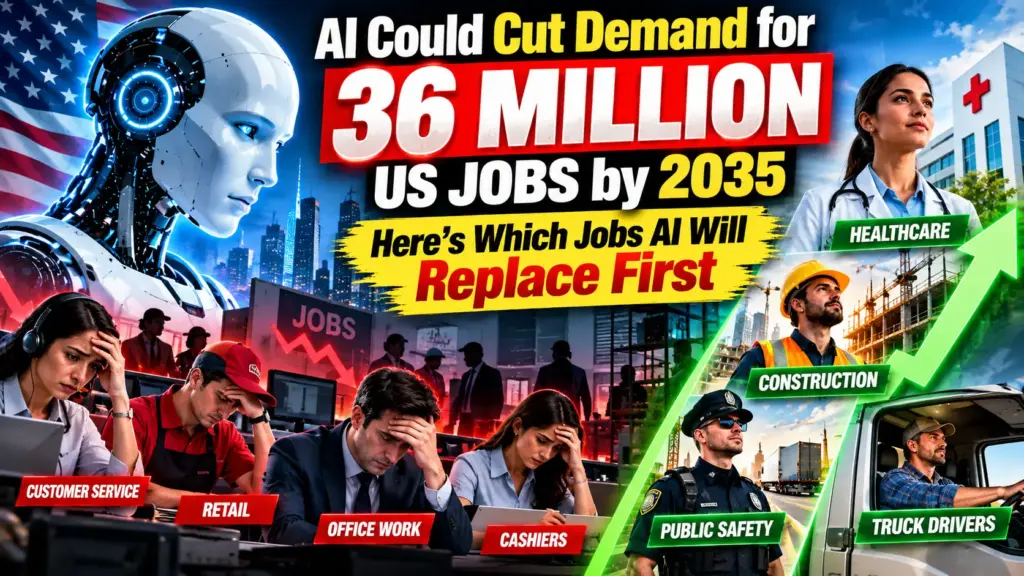
Every few months, a new headline tells you AI is coming for your job. This week’s version comes from a McKinsey Global Institute report with a big number attached: automation could reduce demand for the equivalent of 36 million US jobs by 2035.
Read the whole report, though, and the picture is less apocalyptic and more complicated. The same research says the US could end up with more jobs in 2035 than today. So the useful question isn’t whether AI replaces jobs. It’s a more specific one: what jobs will AI replace by 2035, which ones will it mostly just change, and what does that mean if you’re one of the people in the middle.
SpaceX Just Rattled Verizon, AT&T and T-Mobile in a Single Day. Here’s Why Investors Panicked
What McKinsey Actually Found
Start with the headline math. McKinsey’s base estimate is that automation reduces labor demand by roughly 36 million jobs’ worth of work over the next decade, about 21% of current work hours. At the same time, growth in AI-related industries and the broader economy could create demand for more than 40 million jobs. Net, that’s a gain of around 5 million.
The part that gets lost in the headlines is who actually has to change careers. Of the 36 million jobs affected, about 25 million workers should be able to stay in their current occupation, because growth in their field offsets the automation. The remaining 11 million, roughly 7% of today’s workforce, may need to move into entirely different occupations. McKinsey puts the plausible range at 6 million to 16 million depending on how fast companies adopt AI.
One caveat the researchers are upfront about: these are model outputs under a set of assumptions, not measurements of things that have already happened. Treat the numbers as a well-researched scenario, not a prediction carved in stone.
Which Jobs Will AI Replace First?
The research points to one cluster of work again and again: routine, high-volume, easy-to-verify tasks.
Office and administrative support has the highest expected exposure, with roughly 80% of current work hours potentially automated by 2035. Technology and analytics roles come in around 70%, and retail and sales around 68%. More than 75% of the workers who may need to switch occupations sit in just three groups: office and administrative support, retail and sales, and transportation and logistics.
At the individual job level, about a third of the people likely to need a new occupation are in five roles:
- Customer service representatives
- Retail sales associates
- Office assistants
- Cashiers
- Warehouse workers

There’s an important distinction hiding in those percentages, though. “80% of work hours automated” does not mean 80% of those jobs vanish. Across the whole economy, McKinsey estimates automation could absorb about 54% of current work hours, but organizational and market forces offset roughly 60% of that, leaving the net 21% drop in labor demand. Legal work is a good example: automation could touch about 47% of the hours, but the projected loss in demand is only around 18%, because lawyers shift toward judgment-heavy work as routine research gets automated.
Which Jobs Are Safest From AI?
If you’re wondering which jobs are safe from AI, the pattern runs opposite to the list above. Work that depends on physical presence, human interaction, regulation, or high-stakes accountability tends to adopt automation more slowly.
McKinsey expects automation to reach only about 26% of work hours for healthcare professionals and 28% for public safety and security roles. Healthcare and construction are also where job growth is most concentrated, with roughly 5 million jobs added across the two. Even a role people assume is in trouble can surprise you: tractor-trailer truck driver employment is projected to rise from about 1.3 million to 1.5 million, because the driving and cargo handling that need a human on the road stay put even as paperwork and scheduling get automated.
Still, “safe” isn’t the same as “untouched.” The report is blunt that most jobs will be reinvented even where employment holds steady. Teachers, for instance, are projected to shrink only modestly, but how they spend their day shifts toward direct student support and away from planning and admin.
Who Is Most Likely to Be Hurt
The uncomfortable finding is that the burden isn’t spread evenly. Lower-wage workers are about 7.6 times more likely to need to switch occupations than higher-wage workers. Workers without a college degree are roughly 1.8 times as likely, and younger workers and women about 1.6 times as likely, largely because of which occupations they’re concentrated in.
The reason this matters is the gap between jobs existing and workers being able to reach them. Only about one in seven displaced workers has a “direct” pathway to a growing job, meaning similar skills, little retraining, and no pay cut. Nearly half face an unpaved route with big skill gaps. Roughly 85% of the growing jobs require some credential, and for about 38% of growing employment that credential is legally required. In the researchers’ words, the next decade’s challenge is mobility, not scarcity.
Will AI Take My Job? A Quick Self-Check
You can’t get a personal verdict from a national report, but the research does suggest three useful questions:
- How routine and codifiable is your daily work? The more it follows repeatable steps with easy-to-check outputs, the faster automation tends to arrive.
- How much of it depends on judgment, physical presence, trust, or human relationships? Those parts adopt AI more slowly.
- How quickly is your industry adopting these tools? Two companies with similar jobs can see very different outcomes depending on leadership choices.
Notice that the answer depends on your actual task mix, not your job title. Two people with the same title can face very different risk.
How to Prepare for AI Job Changes
The most practical takeaway from the report is about skills rather than panic. Demand for AI fluency in job postings has risen about 11 times since 2022, while demand for adaptability has grown fivefold and demand for curiosity, resilience, and willingness to learn has roughly tripled.
In practice, that points to a few concrete moves. Get hands-on with the tools your field is already adopting, whether that’s a free AI writing tool or a general assistant, since being comfortable using them is now a baseline expectation rather than a bonus. If you’re unsure which assistant fits your work, a side-by-side comparison of ChatGPT, Claude, and Gemini is a reasonable place to start. Look at the skills you already have that travel well, like coordination, scheduling, customer communication, and problem-solving, and map them to growing fields. McKinsey’s own example is an office assistant moving into project management, a winding but realistic path with around 58% skill overlap and a large potential pay increase, though it may require a degree or certification.
Check credentials early. Because so many growing jobs require them, finding out what’s legally required before you commit to a move saves a lot of wasted effort.
Why Nobody Knows for Sure
Honest caveat time. Forecasts like this swing widely, and tech leaders themselves disagree. Nvidia’s Jensen Huang has argued AI will create jobs in infrastructure and skilled trades, while Anthropic’s Dario Amodei has warned about heavy white-collar losses. Real-world data is messy too. Software developer job postings fell sharply after 2022, then rose about 15% since early 2025, with today’s gaps concentrated in senior and AI-oriented roles.
That’s also why the broader economic picture matters. AI investment is already carrying a large share of US growth, and companies are racing to embed engineers who can get AI working inside real businesses, which tells you the technology is being deployed seriously, not just discussed.
The jobs AI will replace first are the routine, high-volume ones: office support, customer service, cashiers, and warehouse work. The jobs most likely to hold up involve physical presence, human trust, and accountability. For most people, the realistic outcome isn’t losing a job overnight but watching their job change, and the workers who adapt fastest will be the ones who treat learning new tools as part of the job rather than a reaction to a layoff notice.
Disclaimer:- General information only, not personalized career or financial advice.